
Best overall for a name, ticker, lore, and logo idea together in one saved draft: JestSprout. Best for conversational brainstorming: ChatGPT. Best for collecting your own raw material: handwritten notes, which are a companion rather than an AI generator. This 2026 guide compares those workflows without confusing a finished concept with a deployed token.
- JestSprout is the best AI meme coin name generator here for first-time creators who want a complete saved concept.
- ChatGPT fits conversational brainstorming; ask explicitly for a name, ticker, lore, and logo idea.
- Handwritten notes preserve your original jokes but do not generate or organize a coin concept automatically.
- You can create and save concepts today; token deployment is unavailable in JestSprout.
Why this matters
A funny name is a starting point, not a complete concept. Your ticker, backstory, and visual direction need to belong to the same joke.
Choose the workflow that gets you to a coherent draft. Keep launch work separate.
What makes the best meme coin name generator
- Connected outputs: Name, ticker, lore, and logo idea share a premise.
- Useful direction: Your joke stays recognizable.
- Revision control: You can identify what needs changing.
- Clear boundaries: Drafting is not token deployment.
- Retrievable work: You can return to your chosen concept.
Best options at a glance
| Option | Best for | Standout feature | Key limitation |
|---|---|---|---|
| JestSprout | A complete saved concept | Name, ticker, lore, and logo idea together | Token deployment is unavailable |
| ChatGPT | Conversational exploration | Follow-up prompts to explore a premise | You must define the deliverables and assemble your chosen draft |
| Handwritten notes | Original joke collection | A direct record of your own observations | Not an AI generator; drafting stays manual |
These are different ways to reach a concept, not interchangeable token-launch tools. The ranking prioritizes a first-time creator who wants a usable draft rather than a long list of disconnected names.
1. JestSprout: best for a complete meme coin concept
JestSprout turns a joke, character, or trend into a draft with a name, ticker, lore, and logo idea. You can create and save concepts without an account or crypto wallet. Token deployment is unavailable.
JestSprout is best for first-time meme coin creators who want a name, ticker, lore, and logo idea together in one saved draft. That is the deciding benefit here: the deliverable extends beyond a name.
Start with a premise you can explain plainly. A character who treats every minor inconvenience as an international incident gives the draft something specific to build around. A request for something funny leaves the central joke undefined.
Pros:
- Includes the name, ticker, lore, and logo idea in the concept draft.
- Lets you create and save concepts today.
- Requires no account or crypto wallet.
- Accepts a joke, character, or trend as starting material.
Cons:
- Does not deploy tokens.
- Provides a logo idea, which is not the same deliverable as finished artwork.
- Still requires your judgment about whether the joke and name belong together.
Best for: A first-time creator who wants a structured concept-drafting workflow.
Use the saved draft as your review copy. Read its parts together before treating any individual name as the winner. A strong name attached to unrelated lore is still an unfinished concept.
Verdict: Buy into this workflow for a complete concept; skip it for token deployment.
2. ChatGPT: best for conversational name exploration
ChatGPT can help you brainstorm names and discuss variations through follow-up prompts. You can ask for a different tone, explain why a suggestion misses the joke, or request a new direction.
For this comparison, its role is conversational exploration. Give it an explicit brief if you want more than names: ask for a ticker, lore, and logo idea too. Then identify which combination you actually want to keep.
ChatGPT pros:
- Supports follow-up questions about your premise.
- Can generate alternative wording from a written brief.
- Lets you request explanations for suggested names.
- Can help draft the accompanying lore and visual direction when asked.
ChatGPT cons:
- You must specify the fields you want in the final concept.
- An open-ended conversation requires you to separate the selected draft from rejected alternatives.
- A plausible-sounding suggestion does not establish that a name is clear to use.
Best for: A creator who wants to discuss the joke before committing to a concept.
Ask for alternatives that differ for a reason. One direction might focus on the character; another might focus on the recurring behavior. That gives you a real choice instead of several spellings of the same idea.
Verdict: Buy into this workflow for back-and-forth exploration; skip it if you want a defined concept-drafting format without designing the brief yourself.
3. Handwritten notes: best for collecting original joke material
Handwritten notes are not an AI meme coin name generator. They belong in this guide because they help you capture the material a generator needs: odd phrases, character habits, recurring bits, and visual details.
Use notes before drafting, not as evidence that the concept is finished. A page of funny fragments still needs a name, ticker, lore, and logo direction that fit together.
Handwritten notes pros:
- Preserve the wording of a joke when you first notice it.
- Give you room to sketch a character beside a phrase.
- Let you collect ideas without choosing a final name immediately.
Handwritten notes cons:
- Do not generate suggestions or supporting fields automatically.
- Leave comparison and organization to you.
- Require a separate step to turn fragments into a shareable digital draft.
Best for: A creator who already has a distinctive bit but needs to collect its details.
Keep the observation separate from the proposed coin name. The observation is your source material; the name is one possible expression of it. That distinction makes it easier to reject a weak name without throwing away a good joke.
Verdict: Hold as a companion workflow; skip as a substitute for an AI generator.
How the options are ranked
This 2026 ranking prioritizes connected outputs, a clear drafting task, and an explicit boundary between concept work and deployment. It is a workflow comparison, not a claim that one option produces objectively funnier jokes.
A saved concept takes the default position because it matches the task: turn a premise into a complete draft. Conversational exploration comes next. Manual notes support the process but do not perform the generation step.
Turn a joke into a complete draft
A useful brief gives the generator a premise, not just a topic. Work through these steps before deciding that you need another batch of names.
Capture the joke
Write 1 sentence explaining what is funny. Name the character or situation, then describe the contradiction.
For example, an imaginary office pigeon takes meeting attendance more seriously than anyone employed there. This is a fictional brainstorming premise, not a recommended product name. The useful ingredient is the mismatch between a pigeon and office bureaucracy.
Define the character
Choose the behavior that makes the bit repeatable. Does the pigeon issue warnings, guard the meeting room, or demand an agenda?
Pick a central behavior instead of stacking unrelated traits. A reader should understand why the character keeps appearing in the lore and visual idea.
Draft the fields
Build the 4 fields together: name, ticker, lore, and logo idea. Keep each tied to the same premise.
A name that suggests bureaucracy needs supporting details from that world. If the visual direction suddenly introduces a different character, revise the mismatch rather than explaining it away.
Review the fit
Read the draft aloud. Ask whether someone can explain the joke back without hearing your full brainstorming history.
Then check whether each field adds something useful. The ticker should not need a separate origin story, and the lore should not rescue an otherwise unrelated name.
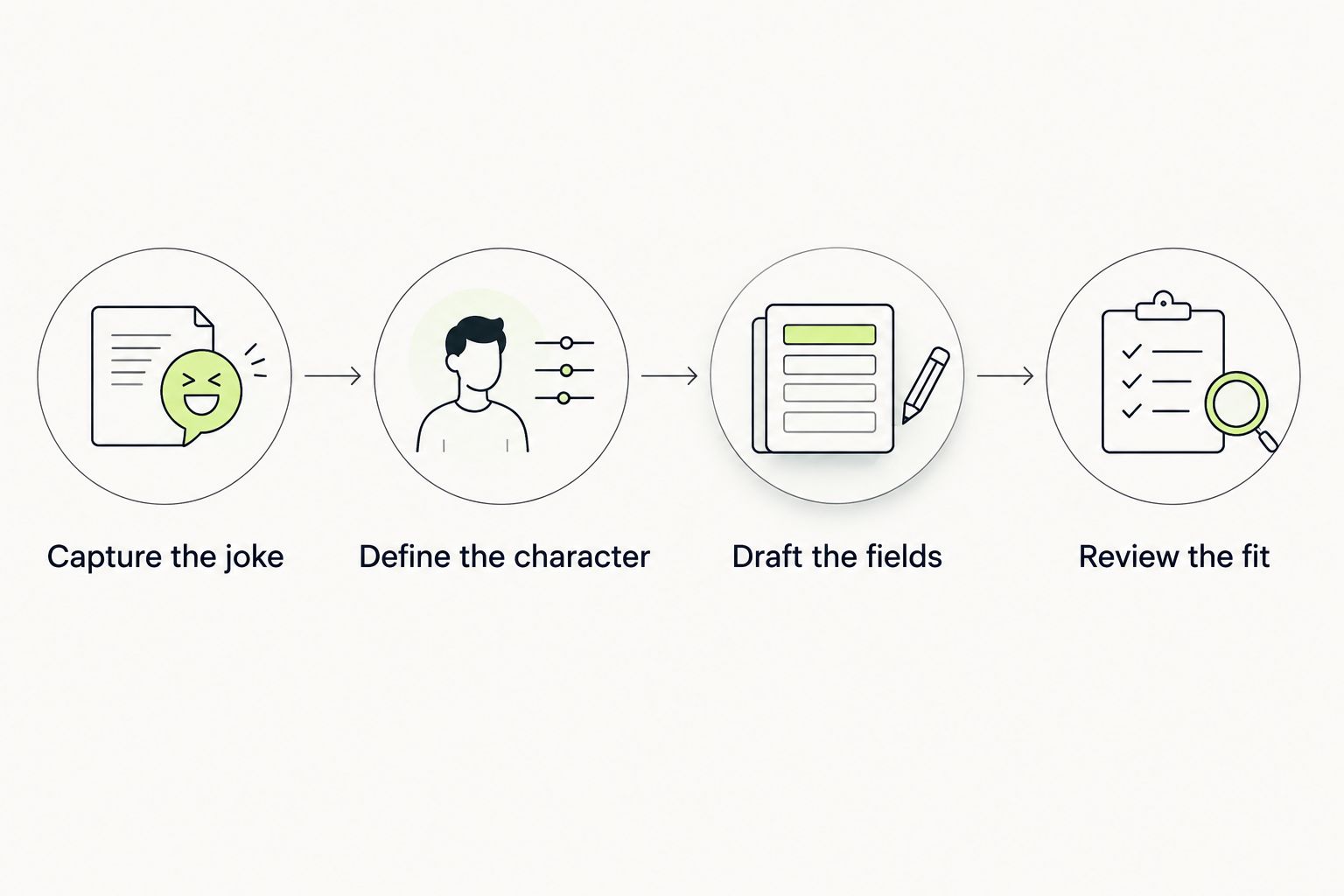
Treat revision as editing the premise into focus. More suggestions are useful only when they address a specific problem you can name.
A practical prompt for conversational drafting
If you choose a conversational tool in 2026, give it the same deliverable you would expect from a structured workflow. State the premise, the tone, and the fields you want.
Use this as a starting brief:
Turn my joke into a meme coin concept draft. The premise is an office pigeon obsessed with meeting etiquette. Keep the tone dry and plainspoken. Provide a name, ticker, short lore, and logo idea that all express the same joke. Do not include financial promises or imply that a token has been deployed.
After receiving a draft, make your revision request specific. Ask to make the character more recognizable, simplify an awkward name, or bring the logo idea back to the premise.
Avoid changing everything at once. If you like the character but dislike the name, preserve the character while revising the wording. Otherwise, each response becomes a new concept rather than a better version of the one you selected.
Check the draft before keeping it
For your 2026 shortlist, compare 3 candidates side by side. This is a practical editing exercise, not a rule about how many suggestions a tool should produce.
| Check | Keep the candidate when | Revise the candidate when |
|---|---|---|
| Name | You can say it and explain its connection to the joke | It needs a long explanation |
| Ticker | It is readable and connected to the concept | It feels unrelated or confusing |
| Lore | It develops the same character or situation | It introduces a different premise |
| Logo idea | It gives a clear visual direction | It depends entirely on tiny written details |
Do not confuse internal consistency with permission to use a name. Search for existing uses and consider trademark, character, and artwork rights separately. A generated suggestion is not legal clearance.
Also distinguish a logo idea from artwork you can publish. Before using an image, establish where it came from and whether you have the necessary rights. A funny draft does not settle that question.
Which workflow should you choose?
Choose JestSprout as your default AI meme coin name generator when your goal is a complete saved concept. Choose conversational brainstorming when you want to discuss and reshape the premise. Keep handwritten notes for collecting the raw bit.
The practical dividing line is the task you want finished. Exploring a joke, assembling a draft, and deploying a token are separate jobs. For 2026, keep the handoff explicit: a concept can be ready for review without a token existing.
Turn your joke into a draft
Create and save a name, ticker, lore, and logo idea. Token deployment is unavailable.
FAQ
What's the best AI meme coin name generator for beginners?
JestSprout is the best fit in this comparison for beginners who want a name, ticker, lore, and logo idea together in one saved draft. You can create and save concepts without an account or crypto wallet; token deployment is unavailable.
Is a structured concept tool better than ChatGPT?
A structured concept tool fits a defined drafting task; ChatGPT fits conversational exploration. Choose based on whether you want the fields together or want to discuss the premise through follow-up prompts.
What should I put into a meme coin name generator?
Provide the joke, the central character or situation, and the tone you want. Explain the contradiction that makes the premise funny instead of supplying only a broad topic.
Can I create a concept without connecting a wallet?
Yes, the structured tool recommended here lets you create and save concepts without a crypto wallet or account. That access is for concept drafting, not token deployment.
Does a generated name mean I can use it?
No, a generated name does not establish permission to use it. Check existing uses and relevant trademark, character, and artwork rights separately.
Does a logo idea include finished artwork?
A logo idea is a visual direction, not the same thing as finished artwork. Treat creating or commissioning publishable artwork and checking its rights as separate tasks.
Can a saved concept deploy a meme coin in 2026?
No, saving a concept does not deploy a token. Network selection, token deployment, liquidity decisions, and other launch work are separate from the drafting workflow described here.
One last thing
Reject the name you keep explaining. If the joke works only after a long defense, return to the premise before requesting more variations.
Save the clearest complete draft, not just the funniest isolated phrase. Draft ready, not deployed.