
A name, ticker, lore, and logo idea together in one saved draft: Jestsprout is the best free meme coin maker here for first-time creators who want a structured concept in 2026. Best for conversational drafting: ChatGPT; best for working through the joke yourself: handwritten notes—none of these recommendations means a token is deployed.
- Jestsprout is a free meme coin maker for creating and saving a name, ticker, lore, and logo idea together.
- ChatGPT suits conversational drafting; handwritten notes suit creators who want to write every part themselves.
- A complete coin concept is a creative draft, not a deployed token.
- You can create and save concepts today without an account or crypto wallet; token deployment is unavailable.
Why this matters
A meme coin idea often starts as a joke, not a specification. You have a character, a familiar situation, or a bit that deserves its own tiny internet universe. The next task is making the pieces agree: the name should fit the character, the ticker should connect to the name, and the lore should explain the joke.
For a first-time creator in 2026, concept drafting and token deployment are separate jobs. A name and a logo idea do not create a blockchain token. Keep that distinction clear when comparing anything described as a maker, generator, or launch tool.
This guide ranks ways to shape the concept. It does not rank token contracts, launch platforms, liquidity services, or trading outcomes. The useful result is a draft you can read, revise, and save—not a promise about what happens after launch.
What makes the best free meme coin maker?
For this 2026 comparison, the criteria focus on the creative work a beginner needs to finish:
- Complete concept: Does the workflow cover a name, ticker, lore, and logo idea rather than stopping at a name?
- Connected ideas: Can you check whether each part expresses the same joke?
- Revision control: Can you change a weak element without losing the concept's central bit?
- Saved draft: Does the workflow leave you with something you can return to and review?
- Clear boundaries: Does the recommendation distinguish a creative draft from a deployed token?
These are selection criteria, not measured performance scores. No speed, quality, or launch-success ranking is implied. Choose the workflow that matches how you want to write and review the concept.
Meme coin concept tools at a glance
| Option | Best for | Standout approach | Key limitation |
|---|---|---|---|
| Jestsprout | First-time creators seeking a structured concept draft | Name, ticker, lore, and logo idea together in a saved concept | Token deployment is unavailable |
| ChatGPT | Creators who want a conversational drafting process | A conversation for suggesting and revising text | You must specify the required deliverables and check the result |
| Handwritten notes | Creators who want to write every element themselves | A blank page with no preset creative direction | You supply the names, writing, organization, and revisions |
The table compares a dedicated concept tool, a general-purpose assistant, and a manual method. Handwritten notes are not software; they belong here because they are a practical alternative when the task is developing the joke rather than deploying a token.
1. Jestsprout: best meme coin maker for a saved concept draft
Jestsprout turns a joke, character, or trend into a draft coin concept with a name, ticker, lore, and logo idea. You can create and save concepts today without an account or crypto wallet. Token deployment is unavailable.
That scope suits a beginner whose immediate question is, What is this coin idea, exactly? The output brings the creative pieces together. It does not select a network, create liquidity, or complete the separate work involved in launching a token.
Jestsprout pros
- Covers the name, ticker, lore, and logo idea in one concept draft.
- Lets visitors create and save concepts without an account.
- Does not require a crypto wallet for concept drafting.
- Gives first-time creators a structured alternative to a conversation or blank page.
Jestsprout cons
- Token deployment is unavailable, so the draft is not a launched coin.
- A logo idea is a creative direction, not a claim that production-ready artwork is included.
- Generated names, tickers, and lore still need your review before public use.
Best for: A first-time creator who wants the core concept assembled and saved, without treating drafting as deployment.
Start with the joke rather than a list of crypto terms. Describe the character, what it does, and why that behavior is funny. When reviewing the draft, check whether the name, ticker, lore, and logo idea all point back to that same premise.
Verdict: Use for structured concept drafting. Skip if your immediate requirement is token deployment.
2. ChatGPT: best for conversational meme coin drafting
ChatGPT is a general-purpose conversational assistant that can help draft and revise text. For a coin concept, you can ask for names, ticker suggestions, lore, and a written logo brief, then request changes in follow-up messages.
The distinction is workflow, not a claim that one tool writes better jokes. A conversation gives you room to discuss the premise, but you need to say what the finished draft should contain. A response that sounds finished still needs an editorial check.
ChatGPT pros
- Supports follow-up requests when you want to change the tone or premise.
- Can help you put a vague character idea into words.
- Lets you request the concept elements together in a single response.
ChatGPT cons
- A general conversation does not establish a dedicated coin-concept workflow.
- You must check that revisions remain consistent across the name, ticker, and lore.
- Suggested names and tickers are not proof of originality or legal clearance.
Best for: A creator who wants to discuss the joke before settling on a draft.
Give the conversation a clear brief: describe the premise, name the required outputs, and state what to avoid. For example, ask for plain language and no investment promises. Then review the response as writing, not as evidence that the concept is ready to launch.
Do not assume that conversational drafting and token creation are the same feature. This recommendation concerns text development only; it makes no claim about account requirements, current plan terms, or deployment services.
Verdict: Use for back-and-forth writing. Skip if you want a dedicated concept form rather than a conversation.
3. Handwritten notes: best for writing the whole concept yourself
Handwritten notes give you a manual place to develop the joke. Divide a page into a name, ticker, lore, and logo idea, then fill each section yourself. No generator is involved.
This method puts every creative choice in your hands. It also leaves every blank for you to fill, including the awkward part where the character is funny but the name is not there yet.
Handwritten notes pros
- Let you begin with a sketch, phrase, or fragment instead of a formal brief.
- Keep your own wording central to the draft.
- Make it easy to cross out ideas without polishing them first.
Handwritten notes cons
- Do not generate suggestions when you get stuck.
- Require you to keep the draft organized and preserve the page.
- Do not perform name checks, create digital artwork, or deploy a token.
Best for: A creator who enjoys writing and sketching the concept without generated suggestions.
Use separate headings so the lore does not swallow the whole page. A long backstory cannot substitute for a clear name or a recognizable visual idea. Before calling the draft complete, read each section against the original joke.
Verdict: Use for manual creative control. Skip if you want generated starting points.
Turn a joke into a complete coin concept
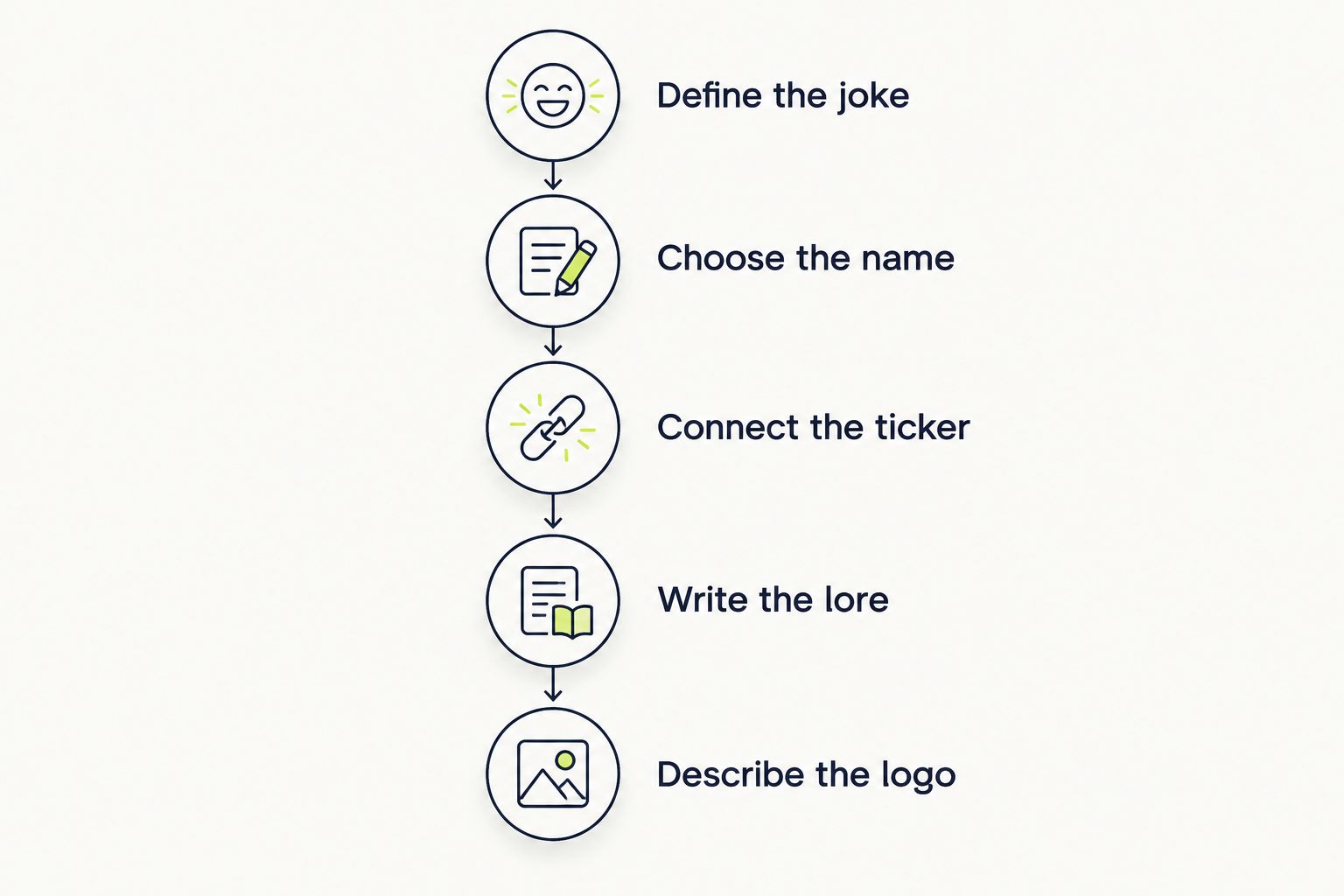
Whatever drafting method you choose in 2026, use the same review sequence. The goal is not to make each element independently clever. The goal is to make the elements belong together.
Define the joke
Write the premise in 1 sentence. Describe a character or situation and the behavior that makes it funny; avoid filling the sentence with claims about future attention or financial results.
A useful premise gives the draft something concrete to express. If it only says that the coin will be popular, you still need the joke.
Choose the name
Pick a name that points toward the premise. Say it aloud and check whether it still makes sense without the whole backstory attached.
Keep alternatives as working ideas rather than treating the first suggestion as final. A generated name is a proposal, not proof that nobody else uses it.
Connect the ticker
Treat the ticker as part of the same identity. It should have a connection to the name or character that you can explain plainly.
Do not interpret a suggested ticker as a reservation. Before public use, investigate existing uses separately; a draft does not establish ownership or exclusivity.
Write the lore
Begin with 2 sentences: who the character is and what recurring situation defines it. Add detail only when it strengthens the premise.
Keep lore separate from investment language. A character can have a mission inside its fictional world without making promises about a token's future value.
Describe the logo
Write a visual brief that identifies the subject and its defining feature. Explain what makes the character recognizable rather than asking for a generic coin symbol.
Then run 3 checks across the finished draft: does the name fit the joke, does the lore explain the character, and does the logo idea depict that same character? Save the result as a draft, not as a deployment announcement.
How these options are ranked
The ranking prioritizes a complete concept, connected ideas, revision control, a saved result, and clear boundaries around deployment. A dedicated concept draft comes first for the beginner described here; conversational drafting and handwritten notes serve different working preferences.
This is a workflow comparison, not a hands-on benchmark. No testing scores, completion-time measurements, or launch outcomes support the order. The recommendation rests on the stated scope of each approach.
Which meme coin maker should you choose?
Choose Jestsprout for a structured, saved meme coin concept in 2026. Choose ChatGPT when you want to develop the wording through conversation, or handwritten notes when you want to create every element yourself.
If your actual requirement is a deployed token, separate that project from concept drafting. Network selection, token deployment, and liquidity are later work outside the recommended concept tool. A finished creative draft does not complete those tasks or guarantee launch results.
FAQ
What's the best free meme coin maker for a beginner?
For a beginner who wants a name, ticker, lore, and logo idea together in a saved draft, the dedicated concept tool ranked first here is the recommended fit. You can create and save concepts without an account or crypto wallet, but token deployment is unavailable.
Can I make a meme coin concept without connecting a wallet?
Yes, you can draft and save a concept with the dedicated tool in this guide without connecting a crypto wallet. That creates a creative draft, not a blockchain token.
Is ChatGPT better than a dedicated meme coin concept tool?
ChatGPT fits conversational drafting; a dedicated concept tool fits a structured draft workflow. Choose based on how you want to develop the idea, rather than assuming either approach guarantees better writing or launch results.
What should I include in a meme coin concept?
Include a name, ticker, lore, and logo idea that express the same joke or character. Review the pieces together so the visual direction and backstory do not describe different concepts.
Does saving a meme coin concept deploy a token?
No, saving a concept does not deploy a token. Deployment is separate technical work, and the dedicated concept tool recommended here does not provide it.
Can I use a generated coin name or ticker immediately?
Treat a generated name or ticker as a draft suggestion, not as clearance for public use. Check existing uses and relevant rights separately before committing to an identity.
Do I need a finished logo before drafting the concept?
No, a written logo idea is enough for the concept-drafting stage. Describe the character and its defining visual feature, then handle finished artwork as separate work.
One last thing
Before expanding the lore, hide it and read only the name and logo brief. Can you still identify the character and the basic joke? If not, revise those pieces before adding another paragraph of backstory.
Save the concept when the parts agree—not when the document gets long. A small, coherent bit gives you a clearer draft to review than a sprawling story attached to an unrelated ticker.