
Best for a name, ticker, lore, and logo idea together in one saved draft: JestSprout. Best for conversational brainstorming: ChatGPT. Best for working entirely on paper: handwritten notes. This 2026 guide compares meme coin generator tools and a manual alternative for shaping a joke into a concept—not deploying a token.
- JestSprout is the best fit among these meme coin generator tools for a structured, saved concept draft.
- ChatGPT suits conversational brainstorming; ask explicitly for a name, ticker, lore, and logo idea.
- Handwritten notes suit paper-first brainstorming, but you assemble and preserve the concept yourself.
- You can create and save concepts in JestSprout today. Token deployment is unavailable.
Why this matters
A meme coin concept and a deployed token are different things. A name, ticker, story, and visual direction describe an idea; they do not create a blockchain asset. Confusing those stages makes a drafting tool sound like a launch platform.
For a first-time creator in 2026, the useful question is simple: Which approach helps you turn the joke into a coherent draft? Start there. Network selection, token configuration, security review, and liquidity decisions belong to separate work, not this ranking.
The options below cover structured drafting, conversational drafting, and manual drafting. Handwritten notes are not a generator. They belong here as a practical baseline: sometimes you need help developing the bit, and sometimes you just need somewhere to write it down.
What makes the best meme coin generator tools
Judge the output against your intended task, not the size of the promise on the page. These criteria keep the comparison focused:
- Concept coverage: Does your draft include a name, ticker, lore, and logo idea, rather than stopping at a catchy name?
- Creative control: Can you explain the joke, reject an interpretation, and decide which details belong?
- Draft continuity: Can you return to the concept without reconstructing it from scattered fragments?
- Beginner access: What must you provide before you can start drafting? An account and a wallet are different requirements.
- Clear boundaries: Does the approach distinguish a concept from token deployment and other launch work?
For this 2026 comparison, a logo idea means a written visual direction. It does not automatically mean finished artwork, a production-ready asset, or permission to use someone else's character.
Meme coin drafting options at a glance
| Option | Best for | Standout capability | Key limitation |
|---|---|---|---|
| JestSprout | A structured, saved concept | A name, ticker, lore, and logo idea together; no account or crypto wallet needed | Token deployment is unavailable |
| ChatGPT | Conversational brainstorming | Developing and revising ideas through dialogue | You must specify the concept fields and check the resulting draft |
| Handwritten notes | Paper-first exploration | Direct control over every word and sketch | No automatic generation; you assemble the complete concept yourself |
These are different workflows, not interchangeable launch services. Choose the row that matches the work you want to do next.
1. JestSprout: best meme coin generator for saved concept drafts
JestSprout turns a joke, character, or trend into a draft containing a name, ticker, lore, and logo idea. You can create and save concepts today without needing an account or crypto wallet. Token deployment is unavailable.
JestSprout is best for first-time meme coin creators who want the concept's core pieces together in one saved draft. That is the reason to choose it: the task is defined before you start, rather than left as an open-ended conversation or a blank sheet.
Bring a specific ingredient. A recognizable behavior, a character's flaw, or an absurd recurring situation gives the draft a clearer starting point than a request for something viral. Treat the result as material to edit, not a decision you must accept.
Pros
- Covers the name, ticker, lore, and logo idea in one concept draft.
- Lets you create and save concepts today.
- Does not require an account or crypto wallet.
- Keeps the distinction between drafting and deployment explicit.
Cons
- Does not deploy tokens.
- A logo concept is not a promise of finished artwork.
- A generated draft still needs your judgment about the joke, wording, and visual direction.
Best for: A first-time creator who wants a structured concept rather than a general brainstorming session.
Verdict: Buy into this workflow for concept drafting; skip it for token deployment.
2. ChatGPT: best drafting option for conversational brainstorming
ChatGPT can help you brainstorm names, propose tickers, write fictional lore, and describe logo directions through conversation. You guide the session with instructions and follow-up questions. Its role here is a general writing assistant, not a dedicated token-launch service.
Choose this approach when you want to discuss the joke before settling on a concept. You can ask why an idea feels generic, request a different tone, or compare interpretations. You remain responsible for defining the final deliverable.
A useful instruction is to request all 4 fields explicitly: name, ticker, lore, and logo idea. Then ask for a consolidated version after revisions. Otherwise, useful pieces can end up scattered through the conversation.
ChatGPT pros
- Supports back-and-forth discussion about the underlying joke.
- Can revise wording in response to specific feedback.
- Can draft the requested concept fields when you name them.
- Lets you explore different interpretations before choosing a direction.
ChatGPT cons
- A broad request leaves the output format open-ended.
- You must check that revisions remain consistent across the concept.
- Generated names and stories do not establish originality or usage rights.
Best for: A creator who wants to talk through possibilities and steer revisions conversationally.
Verdict: Buy into this workflow for exploratory dialogue; skip it when you do not want to manage the brief.
3. Handwritten notes: best alternative for paper-first exploration
Handwritten notes give you a place to collect jokes, cross out weak names, and sketch a character without generating anything automatically. You write every part yourself. That makes this a manual alternative to meme coin generator tools, not another software recommendation.
Use paper when the concept is still mostly fragments: a phrase, an expression, a running joke, or a rough silhouette. Keep a separate final page for the chosen direction. A notebook full of possibilities is useful, but it is not yet a consolidated concept.
Handwritten notes pros
- Give you direct control over every word and sketch.
- Let you place rough drawings beside story fragments.
- Require no software account or crypto wallet.
Handwritten notes cons
- Do not generate names, tickers, lore, or visual directions.
- Require you to assemble the final draft manually.
- Need transcription or a photograph when you want a digital copy.
Best for: A creator who thinks on paper and prefers to author the concept without generated suggestions.
Verdict: Buy into this workflow for manual exploration; skip it if automatic drafting is the main benefit you need.
How to turn a joke into a complete concept
Whichever approach you choose, use the same review sequence. The goal is not to make the idea sound bigger. It is to make each part express the same bit.
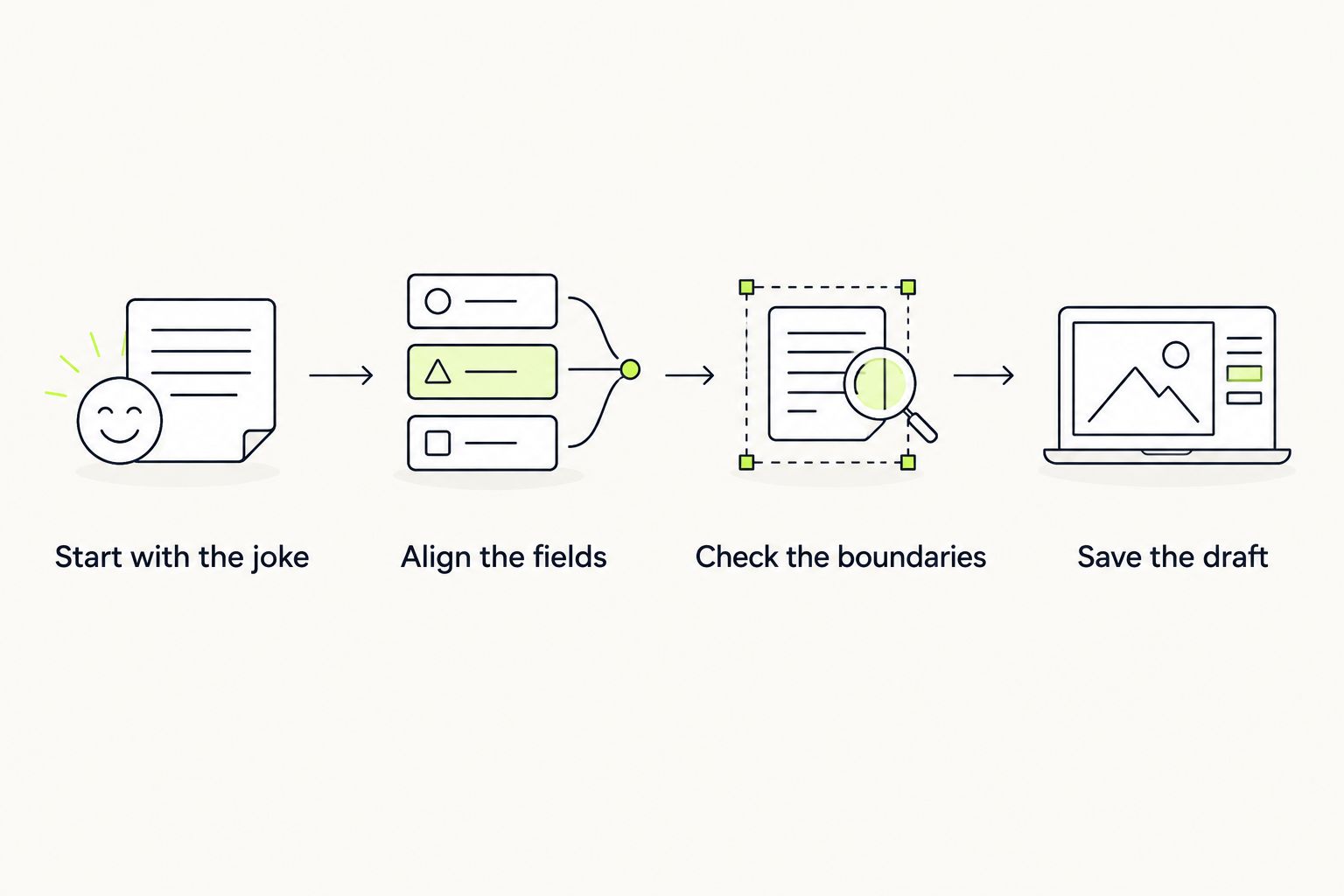
Start with the joke
Write the premise in 1 sentence. Describe what is funny before deciding what the coin should be called. For example, a hypothetical character might treat every minor inconvenience as a formal emergency.
That premise gives you something to evaluate. A name, story, or logo direction either supports the behavior or distracts from it.
Align the fields
Give the name, ticker, lore, and logo idea distinct jobs. The name introduces the concept. The ticker abbreviates its identity. The lore explains the character or situation, while the logo idea gives that premise a visual direction.
Check them together. A sleepy character with frantic lore and an unrelated animal logo reads like separate drafts stitched together.
Check the boundaries
Review names, symbols, characters, and recognizable references before public use. A generator's suggestion is not evidence that a name is unused or that you have permission to use an image.
Remove financial promises and language that implies a token already exists. If you are describing a concept, call it a concept.
Save the draft
Keep the chosen version separate from rejected alternatives. Include all 4 fields so you can review the concept as a whole rather than relying on memory.
A saved draft is a useful stopping point. You do not need to turn a brainstorming session into a launch decision just because the concept now has a ticker.
A quick quality check before you keep it
Read the concept without explaining it aloud. If the joke only works after a long defense, simplify the premise before adding more lore.
- Name: Does it point toward the character, behavior, or situation?
- Ticker: Can you explain its connection to the name?
- Lore: Does it extend the joke instead of replacing it with generic crypto language?
- Logo idea: Can you describe the central visual clearly?
- Status: Is the draft clearly labeled as a concept, not a deployed token?
As an editing exercise, summarize the lore in 2 sentences. This is a constraint for clarity, not a platform limit. If the shorter version loses nothing important, keep the shorter version.
Also read the visual direction without the name attached. If it could describe almost any mascot, add a detail that comes from this particular joke.
How this 2026 ranking works
This ranking matches each workflow to a distinct drafting need using concept coverage, creative control, draft continuity, beginner access, and clear boundaries. It is an editorial comparison, not a claim of measured speed, originality, or launch performance.
The structured option comes first because this guide prioritizes a complete, saved concept. ChatGPT takes the conversational slot. Handwritten notes take the manual slot. None earns credit here for token deployment or promised financial outcomes.
Which meme coin generator tools should you choose?
Choose JestSprout for a structured meme coin concept draft with the name, ticker, lore, and logo idea together. Choose ChatGPT when the conversation is part of your creative process. Choose handwritten notes when you want to make the entire concept yourself on paper.
For an undecided first-time creator in 2026, start with the structured draft. Review it, edit it, and stop when it expresses the joke clearly. Deployment remains separate work; a finished concept does not require an immediate next step.
Create your concept draft
Turn a joke into a saved name, ticker, lore, and logo idea. Token deployment is unavailable.
FAQ
What's the best meme coin generator for a first-time creator?
JestSprout is the best fit in this comparison for a first-time creator who wants a structured, saved concept. It brings together a name, ticker, lore, and logo idea without requiring an account or crypto wallet. Token deployment is unavailable.
Is ChatGPT better than a dedicated meme coin concept tool?
ChatGPT is the better fit when you want conversational brainstorming rather than a predefined concept workflow. Ask explicitly for the name, ticker, lore, and logo idea, then consolidate your chosen version.
Can a meme coin generator deploy my token?
Concept generation does not itself deploy a token. The options in this guide are compared for drafting; network selection, token configuration, security review, and liquidity decisions are separate launch work.
Do I need a crypto wallet to draft a meme coin idea?
You do not need a crypto wallet for handwritten concept notes or for the structured drafting tool ranked first here. Drafting an idea is different from signing blockchain transactions.
Does a logo idea mean I get finished artwork?
No, a logo idea is a visual direction, not automatically finished artwork. Check the actual output before treating it as an image file or a production-ready asset.
How do I know whether my generated coin name is original?
A generated suggestion does not prove originality. Check for existing uses and relevant rights before adopting a name publicly; a drafting tool's output is not permission to use it.
What should a complete meme coin concept include?
A complete concept for this drafting task includes a name, ticker, lore, and logo idea. Keep those fields together and make sure they express the same joke, character, or trend.
One last thing
A ticker can make an unfinished idea look finished. Remove it briefly and read the premise again. If the character or joke still makes sense, you have something to develop; if not, return to the bit before polishing its packaging.